- New
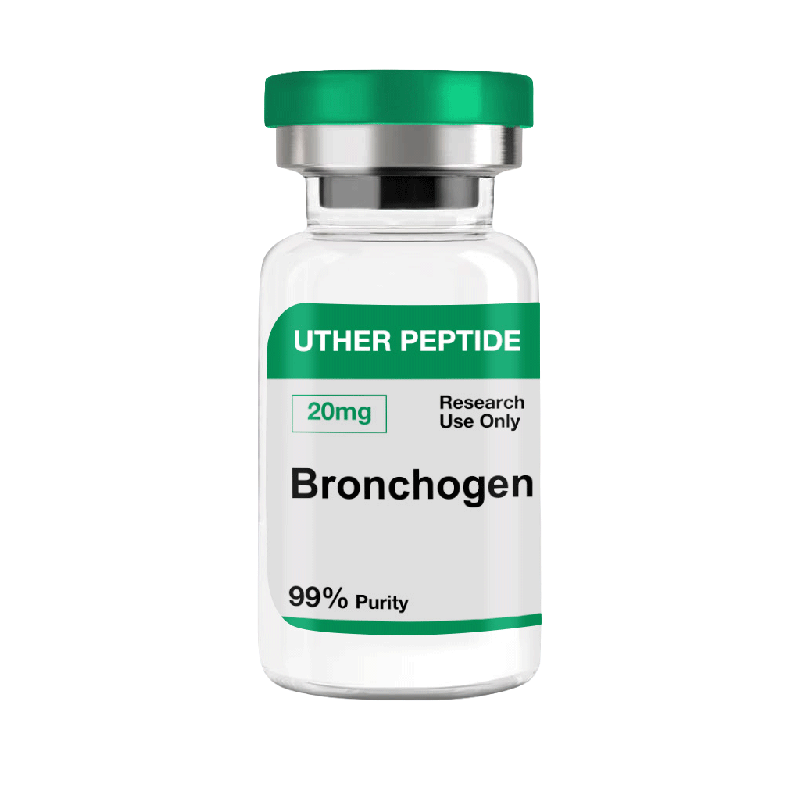
Bronchogen is a synthetic tetrapeptide used as a research tool to investigate tissue-specific gene-expression regulation in bronchial-epithelium experimental systems.
The products offered on this website are furnished for in-vitro studies only. In-vitro studies are performed outside of the body. These products are not medicines or drugs and have not been approved to prevent, treat or cure any medical condition, ailment or disease. Bodily introduction of any kind into humans or animals is strictly forbidden.
 Cut off Times
Order before 15:00 for same day dispatch
 Delivery policy
Royal Mail Tracked 24
 Return policy
Moneyback guarantee
Synonyms / Designations: Bronchogen; AEDL; ADEL; lung (bronchial) peptide bioregulator
Amino Acid Sequence: Ala-Asp-Glu-Leu (ADEL, per primary literature; commonly designated AEDL)
CAS Number: N/A
Molecular Formula: C18H30N4O9
Molecular Weight: 446.45 g/mol
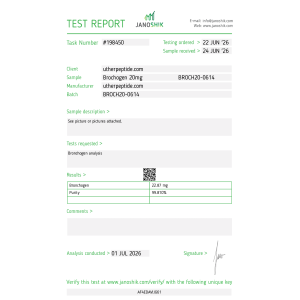
Purity: ≥ 99 % (HPLC)
Appearance: White to off-white lyophilised powder
Pack Size: 20 mg (total)
Storage: Desiccated, protected from light, stored at –20 °C or below
Solubility: Soluble in water and buffered aqueous solutions
Bronchogen is a short synthetic tetrapeptide used as a molecular probe for studying tissue-specific regulation of gene expression in bronchial-epithelium model systems. In cultured human bronchial epithelial cells it has been reported to modulate transcription of mucin and surfactant-associated genes (MUC4, MUC5AC, SFTPA1) and to alter levels of proliferation- and apoptosis-associated proteins.
Within the Khavinson short-peptide model, peptides of this class are studied as candidate cell-penetrating regulators that may interact with DNA and chromatin to influence promoter activity. Bronchogen is therefore used to examine putative peptide–DNA interactions and downstream transcriptional readouts in vitro; observed effects depend on concentration, model system and exposure conditions.
| Parameter | Typical Value / Range |
|---|---|
| Purity (HPLC) | ≥ 99 % |
| Appearance | White to off-white lyophilised powder |
| Molecular Weight | 446.45 g/mol |
| Peptide Type | Synthetic linear tetrapeptide bioregulator (Khavinson cytogen family) |
| Solubility | Water, buffered aqueous solutions |
| Storage | –20 °C, desiccated, dark |
| Pack Size | 20 mg (total) |
Khavinson VKh, et al. Peptide regulation of gene expression and protein synthesis in bronchial epithelium. Lung. 2014;192(5):781-791.
https://pubmed.ncbi.nlm.nih.gov/25015171/
Monaselidze JR, Khavinson VKh, et al. Effect of the peptide bronchogen (Ala-Asp-Glu-Leu) on DNA thermostability. Bull Exp Biol Med. 2011;150(3):375-377.
https://pubmed.ncbi.nlm.nih.gov/21240358/
Khavinson VKh, Popovich IG, et al. Peptide Regulation of Gene Expression: A Systematic Review. Molecules. 2021;26(22):7053.
https://www.mdpi.com/1420-3049/26/22/7053
Keywords: Bronchogen, AEDL, lung peptide bioregulator, synthetic tetrapeptide
Your review appreciation cannot be sent
Report comment
Report sent
Your report cannot be sent
Write your review
Review sent
Your review cannot be sent
Reference: DSIP5
Reference: GHRP6
Reference: COREB45
Reference: GHKCU50
Bronchogen is a synthetic tetrapeptide used as a research tool to investigate tissue-specific gene-expression regulation in bronchial-epithelium experimental systems.
The products offered on this website are furnished for in-vitro studies only. In-vitro studies are performed outside of the body. These products are not medicines or drugs and have not been approved to prevent, treat or cure any medical condition, ailment or disease. Bodily introduction of any kind into humans or animals is strictly forbidden.
check_circle
check_circle